 |
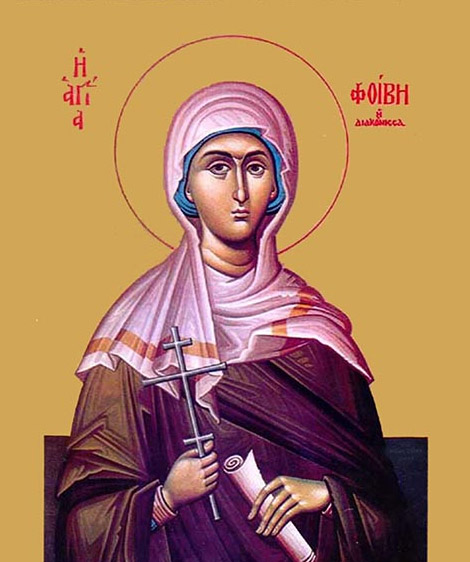
| St. Phoebe the Deaconess |
The following article was written by Dr.Catherine Kroeger who serves as a chaplain and lecturer in the department of
religion at Hamilton College in New Hartford ,
N.Y.
WOMEN WERE THE LAST DISCIPLES at the cross and the first at the
empty tomb. they remained integral to the work of the church in its early
centuries. Catherine Kroeger scours historical data to compile an impressive
collection of stories about noteworthy women in the early church.
One of the best-kept secrets in Christianity is the enormous
role that women played in the early church. Though they leave much unsaid,
still, both Christian and secular writers of the time attest many times to the
significant involvement of women in the early growth of Christianity.
Celsus, a 2nd-century detractor of the faith, once taunted that
the church attracted only “the silly and the mean and the stupid, with women
and children.” His contemporary, Bishop Cyprian of Carthage
Why? One reason might have been the practice of exposing
unwanted female infants—abandoning them to certain death. Christians, of
course, repudiated this practice, and thus had more living females. Also, in
the upper echelons of society, women often converted to Christianity while
their male relatives remained pagans, lest they lose their senatorial status.
This too contributed to the inordinate number of women in the church,
particularly upper-class women. Callistus, bishop of Rome c. 220, attempted to
resolve the marriage problem by giving women of the senatorial class an
ecclesiastical sanction to marry slaves or freedmen—even though Roman law
prohibited this.
These high-born Christian women seized upon the study of the
Bible and of Hebrew and Greek. The circle of Roman women who studied with
Jerome in the late 300s showed such scholarship that he thought nothing of
referring some church elders to Marcella for the resolution of a hermeneutical
problem. By the early 400s, Augustine could declare that “any old Christian
woman” was better educated in spiritual matters than many a philosopher.
The women’s spiritual zeal exploded into social service. Fabiola
founded the first Christian hospital in Europe .
Many other church women encountered severe opposition from their families for
spending their wealth so generously in helping the poor. Such selfless ministry
became a trademark of Christian women. In a letter to his wife, Tertullian
gives us a glimpse into some of the ministries of church women in his time. He
charges her, in case of his own death, to not marry a pagan.
"Who would be willing to let his wife go through one street
after another to other men’s houses, and indeed to the poorer cottages, in
order to visit the brethren? Who would like to see her being taken from his
side by some duty of attending a nocturnal gathering? At Easter time who will
quietly tolerate her absence all the night? Who will unsuspiciously let her go
to the Lord’s Supper, that feast upon which they heap such calumnies? Who will
let her creep into jail to kiss the martyr’s chains? Or bring water for the
saints’ feet?"
WOMEN AS
WITNESSES OF JESUS
It is no surprise that women were active in the early church.
From the very start—the birth, ministry, death and resurrection of Jesus—women
were significantly involved. In fact, women were the major witnesses of his
crucifixion and resurrection. Matthew, Mark and Luke all record that a
significant group of women had followed Jesus in his Galilean ministry, and
that they were present at his execution—when the male disciples were
conspicuously absent.
All three describe the women’s presence at Jesus’ burial. Luke
declares that the women who had followed Jesus from Galilee
still followed along as Christ was carried to the tomb. Mark details the care
with which Mary Magdalene and Mary the mother of Joses noted where He was laid,
while Matthew tells how they kept watch over the sepulchre after the men had
left. John tells of the group immediately beneath the cross, three women and
one man. John alone preserves the garden interview between Mary Magdalene and
the Risen Christ.
All three describe the women’s presence at Jesus’ burial. Luke
declares that the women who had followed Jesus from Galilee
still followed along as Christ was carried to the tomb. Mark details the care
with which Mary Magdalene and Mary the mother of Joses noted where He was laid,
while Matthew tells how they kept watch over the sepulchre after the men had
left. John tells of the group immediately beneath the cross, three women and
one man. John alone preserves the garden interview between Mary Magdalene and
the Risen Christ.
The proclamation of the astounding Easter event was entrusted to
these women. The angel reminded them that they had already been instructed by
Jesus about His death, burial and resurrection. The women remembered and
hurried off to tell the men. Their witness remains an integral part of the
gospel to this day. The early church considered Mary Magdalene an “apostle to
the apostles,” and Luke relied heavily on the testimony of women as he wrote
both Luke and Acts.
The involvement of women continued in the first few decades of
the church, attested by both biblical and extra-biblical sources. A number of
women served as leaders of the house churches that sprang up in the cities of
the Roman Empire—the list includes Priscilla, Chloe , Lydia
In the 2nd century, Clement of Alexandria wrote that the
apostles were accompanied on their missionary journeys by women who were not
marriage partners, but colleagues, “that they might be their fellowministers in
dealing with housewives. It was through them that the Lord’s teaching
penetrated also the women’s quarters without any scandal being aroused. We also
know the directions about women deacons which are given by the noble Paul in
his letter to Timothy."
Was that perhaps the role of Junia? She was mentioned by Paul in
Romans 16 as “of note among the apostles.” Some have debated the meaning of
this verse, but early tradition holds that Junia was a woman and was considered
an apostle. John Chrysostom wrote: “Indeed, to be an apostle at all is a great
thing; but to be even amongst those of note; just consider what a great
encomium that is...Oh, how great is the devotion of this woman, that she should
even be counted worthy of the appellation of apostle."
Until the Middle Ages, the identity of Junia as a female apostle
was unquestioned. Later translators attempted to change the gender by changing
the name to the masculine Junias. But such a name is unknown in antiquity; and
there is absolutely no literary, epigraphical or papyrological evidence for it.
Paul also mentions Phoebe in Romans 16, “a deacon of the church
at Cenchreae.” He calls her a prostatis or overseer. This term in its masculine
form, prostates, was used later by the Apostolic Fathers to designate the one
presiding over the Eucharist. And Paul uses the same verb, the passive of
ginomai (to be or become), as he uses in Colossians 1:23: “I was made a
minister.” In the passive, the verb sometimes indicated ordination or
appointment to an office. Thus one might legitimately translate Paul’s statement
about Phoebe: “For she has been appointed, actually by my own action, an
officer presiding over many.” The church in Rome
The four daughters of Philip
appear in Acts 21:9 as prophetesses. Eusebius viewed these daughters as
“belonging to the first stage of apostolic succession.” Another prophetess
attested to by extra-biblical tradition is Ammia, who prophesied in Philadelphia during New Testament times, and was received
with reverence throughout Asia Minor . The
first preserved mention of her dates to about 160 A.D.
2ND-CENTURY
CHURCH WOMEN
Just as the letters of Paul abound in references to his female
associates in ministry, the Apostolic Fathers also mention women as stalwarts
in the faith. Twice Ignatius sent greetings to Alce, whom he calls especially
dear to him. He also greeted Tavia and her household; perhaps she was another
house-church leader.
Polycarp mentioned the sister of Crescens, who deserved special
commendation when she and her brother arrived in Philippi
to deliver the letter. The Shepherd of Hermas, written about 148 A.D., gives
instructions that two copies should be made of the work and one given to
Grapte, “who shall exhort the widows and orphans.” The other copy was to be
given to Bishop Clement to share with the elders. It appears that Grapte and Clement
represented the female and male leaders respectively. But Christians were not
the only ones prompted to write about the female followers of Jesus. About 112
A.D., the Roman governor Pliny the Younger detailed his efforts to cope with
the nascent church in Bithynia
SPURIOUS
WORKS
Certain female leaders are described as fully historic
personages, while others are embedded in legend. Catherine of Alexandria, for
instance, reportedly lived in the 2nd century, though the earliest reference to
her is in an 8th-century work. The patron saint of scholars and philosophers,
she allegedly debated 50 philosophers and won them all to Christ. As a result,
she was condemned to death and ultimately perished on the wheel (hence the name
of the “Catherine wheel,” a rotating firework).
Her story may have been drawn from that of Hypatia, the noted
pagan philosopher also of Alexandria
Spurious works, even if their authorship is in doubt, can still
have value in demonstrating certain attitudes. Two epistles erroneously
attributed to Ignatius preserve an appeal from Mary of Cassobelae that three
members of the clergy, Maris, Eulogius and Sobelus, be appointed to serve in
her community so that it might not be devoid of those fit to preside over the
Word of God. She begs Ignatius to not deny her request simply because the three
are young and two of them newly ordained. Rather, she argues from the
Scriptures that youth is no deterrent to a significant ministry for God.
Pseudo-Ignatius replies: “Thy intelligence invites us, as by a word of command,
to participate in those divine draughts which gush forth so abundantly in thy
soul . . . Thy numerous quotations of Scripture passages exceedingly delighted
me, which, when I had read, I had no longer a single doubtful thought
respecting the matter . . . Thou art perfect in every good work and word, and
able also to exhort others in Christ."
He promises to comply with her
wishes, citing the fame which had accrued to her earnest dedication to Christ
at the time of her visit to Rome
during the bishopric of Linus (beginning of the 2nd century). The letter is
probably no earlier than the 4th century, but it demonstrates an attitude that
was able to gain currency in the early church. A woman of outstanding spiritual
gifts purportedly gives direction in the appointment of clergy, and is
applauded for the inspiration she affords. The personages may be fictitious,
but the appreciation of feminine spirituality is real.
THE LEGEND
OF ST. THECLA
The legend of St. Thecla has endeared itself to modern women as
well as to their earlier counterparts. It is the bestknown of the numerous
apocryphal stories of early Christian heroines. According to the 3rd century
text of The Acts of Paul, Thecla, a noblewoman, was converted
while listening to the preaching of the apostle. Forsaking her old life, she
followed Paul and endured persecution, tribulation and great peril. The story
resembles the ancient pagan romances in the repetition of hair’s-breadth
escapes, the fortitude and nobility displayed by both hero and heroine, and the
happy ending. It is, however, a Christianized romance, as are several other of
the apocryphal Acts and The Recognitions of Peter.
Thecla appears as a truly heroic character who endures all
manner of suffering for the sake of Christ. After her itineration through Asia
Minor with the Apostle Paul, she settles near Seleucia
Both Gregory of Nazianzus and Basil of Caesarea spoke of Thecla
as a historical figure. Writing in the 300s, they described her teaching center
and hospital near Seleucia Asia
Minor of an extremely strong female leader.
WOMEN IN
CONSECRATED ORDERS
Beside the outstanding achievements of individual women stood
the ministry of consecrated women in specialized orders. These orders included
ecclesial widows, virgins, presbyteresses and deaconesses. Sometimes such women
were formally ordained and sat with the rest of the clergy in front of the
congregation.
Mary McKenna suggests that the disadvantaged women who
accompanied Jesus in his Galilean ministry (Luke 8:23) formed the beginning of
the order of widows. The Greek term cheira might refer to any woman who found
herself in difficult circumstances. Tertullian complained of a virgin who was
admitted to the order of widows at the age of 19! These widows were supported
by the gifts of the congregation, and in turn were expected to pray for their
benefactors as well as for all other members of the church. Their duties and
qualifications were developed from the instructions in 1 Timothy 5. In the
Clementine Recognitions and Homilies, perhaps from the first half of the 3rd
century, St. Peter, as he prepares to leave Tripoli
The widow came to be looked upon as “the altar of God,” both
because of her ministry of intercession and because of the gifts that she
received. Under no circumstances should she reveal the name of a donor, lest
other widows demand an equal gift from the same source or, worse yet, curse the
one who withheld such benefices. The Didascalia insisted that neither “the
bishop nor a presbyter, nor a deacon, nor a widow should utter a curse,”
because widows “had been appointed to bless."
Widows were clearly part of the ordained clergy in the Testament
of Our Lord Jesus Christ, a 5thcentury reworking of earlier material from
Hippolytus’s Apostolic Tradition. The selection process and ordination service
of widows parallels those of deacons, bishops and presbyters. The document
applies the title “presbyteresses” to these women, and six times refers to them
as “the widows who sit in front.” During communion, they stood by the altar,
close to the bishops, presbyters and deacons, and within the veil that screened
off the laity. These widows assumed pastoral responsibilities such as
instructing female catechumens and the ignorant, gathering those who desired to
live a pure life for prayer and encouragement, rebuking the wayward, and
seeking to restore them
WOMEN AS DEACONS
As
Clement of Alexandria
"This text
teaches with the authority of the Apostle that even women are instituted
deacons in the Church. This is the function which was exercised in the church
of Cenchreae by Phoebe, who was the object of high praise and recommendation by
Paul . . . And thus this text teaches at the same time two things: that there
are, as we have already said, women deacons in the Church, and that women, who
by their good works deserve to be praised by the Apostle, ought to be accepted
in the diaconate."
Women deacons appear to be under discussion in 1 Timothy 3:11,
although the feminine form “deaconess” did not come into use until about 100
A.D. As late as the end of the 4th century, diaconos might designate a woman as
well as a man. The order of deaconesses as distinct from that of widows appears
clearly delineated in the first half of the 3rd century in the Didascalia,
which declared that the deaconesses should be honored as figures of the Holy
Spirit. They could visit believing women in pagan households where a male
deacon would be unacceptable. To them belonged the duties of visiting the sick,
bathing those recovering from illness, and ministering to the needy.
Deaconesses also assisted in the baptism of women, anointing them with oil and
giving them instruction in purity and holiness. They could give communion to
women who were sick and unable to meet with the entire church. The Apostolic
Constitutions even specified that both male and female deacons might be sent
with messages outside the city limits. The ministry of the widow was largely
that of prayer, fasting, and laying of hands on the sick, while the deaconess,
usually a considerably younger woman, undertook the more physically arduous
tasks.
Ancient documents show that deaconesses were ordained. The
Council of Chalcedon set down requirements for the ordination of deaconesses,
and the Apostolic Constitutions includes their ordination prayer.
WOMEN AS
ELDERS
The feminine form of “presbyter” or elder occurs frequently,
though it is often translated simply as “old woman.” At times the term
certainly refers to women who were part of the clergy. The Cappadocian father,
Basil, uses presbytera apparently in the sense of a woman who is head of a
religious community. Also applied to women is the term presbutis, “older woman”
or “eldress.” The old woman who instructed Hermas is called presbytis. It
occurs not only in Titus 2:3, but most markedly in Canon 11 of Laodicea, which
forbade the appointment of presbytides (eldresses) or of female presidents
(prokathemenai).
The masculine form, prokathemenos, indicated the presbyter or bishop who
presided over the communion service. Dionysius of Alexandria, who died in 264
A.D., described a martyr as “the most holy eldress Mercuria” and another as “a
most remarkable virgin eldress Apollonia.” A variant reading of the apocryphal
Martyrdom of Matthew, a 4th- or 5th-century document, tells how Matthew
ordained a king as priest and his wife as presbytis, “eldress.” Epiphanius and
Theodoret vehemently repudiated any priestly function accruing to the
“presbytides."
WOMEN AS
PRIESTS?
There are even a few scattered references connecting women to
the priesthood. Pseudo-Ignatius’s Letter to the Tarsians commands that those
who continue in virginity be honored as priestesses of Christ. The eldresses of
Titus 2:3 must be “hieroprepeis,” a term that inscriptional evidence suggests
should be translated “like a priestess,” or “like those employed in sacred
service.” The Cappadocian Gregory of Nazianzus wrote to Gregory of Nyssa about
Theosebia, “the pride of the church, the ornament of Christ, the finest of our
generation, the free speech of women, Theosebia, the most illustrious among the
brethren, outstanding in beauty of soul. Theosebia, truly a priestly personage,
the colleague of a priest, equally honored and worthy of the great
sacraments."
The walls of the Roman catacombs bear pictures showing women in
authoritative stances, with their hands raised in the posture of a bishop. The
Ecclesiastical Canons of the Apostles specifically forbade women to stand in
prayer (24:1-8). But here we see them standing in prayer, exercising a ministry
of intercession and benediction, and dominating the scene. To this day, their
steadfast faith and ministry still bless us.