Thursday, December 25, 2014

The True Story of Santa Claus

He's fat, he's jolly, he says "Ho, ho, ho," drives a sleigh and delivers presents chimney to chimney. But who is he really, and where did he come from before he took up his mythical residence at the North Pole? The Santa Claus character is based on a Roman Catholic bishop, St. Nicholas, the patron saint of children, who was known for his generosity and reputed to have left gifts for children, said Dr. Foster Eich, a retired pediatrician in Florence and author of "The True Story of St. Nicholas, who is also called Santa Claus" (available at Episcopal Book Store for $15.95).

Eich, also an Episcopal priest who serves as priest associate at St. Bartholomew's Episcopal Church in Florence, took up the hobby of researching St. Nicholas about 25 years ago. "This is what we should tell children about Santa Claus,"

Eich said. "He was bishop of Myra, in what's eastern Turkey, then the Greek-speaking Roman Empire. He was born in 280 A.D." The name "Claus" derived as a corruption in pronunciation of the name, "Nicholas," Eich said. "Children had a lot of problem saying St. Nicholas," Eich said. "St. Nicholas is a little hard to say. Children started simplifying it to Santa Claus."

The feast day of St. Nicholas, Dec. 6, was celebrated by the Dutch as a gift-giving day when children put out their shoes to be filled with goodies by St. Nick, who had evolved into a mystical gift-giver with a white beard.

The Calvinist Protestants of northern Germany moved the gift-giving to Christmas and dressed St. Nick in fur instead of bishop's robes. The customs began to emigrate to America in the 1600s.

"Dutch children brought the custom to America," Eich said. In Holland to this day gifts are given Dec. 6.

St. Nicholas underwent an image changeover that got its biggest boost from a poem by the biblical scholar Clement Moore, who taught in Episcopal seminaries. Moore's 1822 poem, "A Visit from St. Nicholas," set the tone for the modern Santa story.

"The image, the picture of him we have is from Clement Moore," Eich said. "He had a man working on his farm who was Dutch. The description fits his farmhand. Moore rode down in a sleigh to pick up some things and on the way home he thought up the poem.

The poem is called, 'A Visit from St. Nicholas.' Nowhwere in it does Moore call him Santa Claus. Clearly, we are talking about the same person."

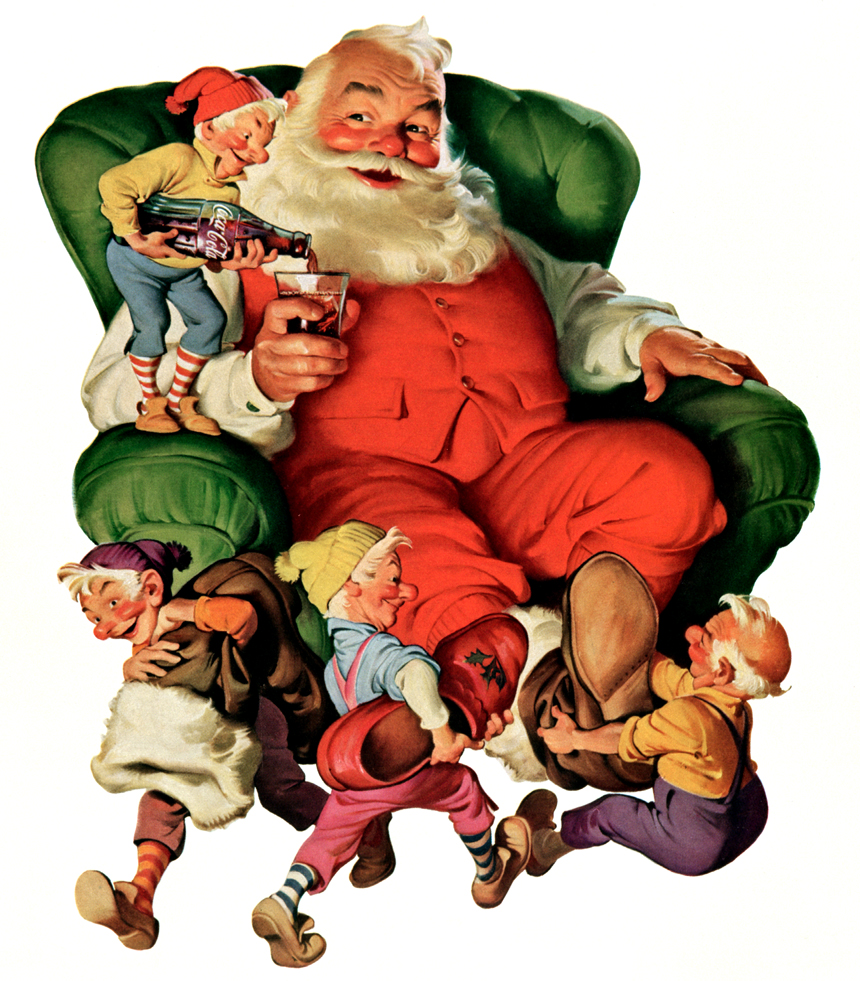
In the 1860s, cartoonist Thomas Nast refined the image of Santa Claus, and in the 1930s Coca-Cola advertising cartoonist Haddon Sundblom helped complete the evolution into a jolly, oversized elf with a kindly face.

Gradually, the religious image was fully transformed into a secular icon. St. Nicholas of Myra was represented in medieval art holding four loaves of bread as a symbol of his generosity.

While archbishop of Lycia, Nicholas was supposed to have helped avert a food shortage by persuading several ships traveling from Constantinople to Alexandria to leave a year's supply of grain when they sought refuge in the harbor of Myra during a storm.

According to legend, he told the ship captains their hoppers would still be full of grain when they reached port, and the prediction proved true. The bishop's persuasion saved many from starvation, so the story goes.

Nicholas may have been infused with some of the magical traits of the Norse god with the flowing beard, called Odin or Woden, who galloped through the air on his eight-legged horse.

Reliable historical information about the real St. Nicholas is hard to come by. St. Nicholas was supposed to have been imprisoned and released at the Council of Nicaea, but no record exists of him taking part in that meeting.

"He is not on the records of the Council," Eich said. "That may be because according to the story, he slapped Arias over his heresy and got kicked out."

No written records of Nicholas exist except those dating 200 years after his death. In medieval times, all sorts of legends sprang up surrounding St. Nicholas.

The most famous one is of the man who couldn't afford to pay the dowry for his three daughters to be married. "In those days a girl had to have a certain amount of money to get married," Eich said. "They might have to be sold into slavery into order to have food." Nicholas sneaks in at night and leaves the dowry so the young women can get married. "He tossed bags of gold in their stockings or shoes," Eich said. "I think the story of the three girls is true. It's a very credible story.

"Even as recently as the early 1960s in Europe, the great celebration and the day of gift-giving was Jan. 6, Epiphany, a commemoration of the Magi bringing gifts to Jesus.

The 12-day season of Christmas runs from Dec. 25 to Epiphany. The Americanization of Europe has gradually overshadowed Epiphany with an American-style Christmas.

"I'm reclaiming him as a Christian symbol," Eich said.

Thursday, December 04, 2014

Irene Sendler - Remember Her Name


Look at this lady - Let us never forget!
The world hasn't just become wicked...it's always been wicked.
The prize doesn't always go to the most deserving.
Irena Sendler 
Died 12 May 2008 (aged 98)
Warsaw, Poland
During WWII, Irena, got permission to work in the Warsaw ghetto, as a plumbing/sewer specialist.
She had an 'ulterior motive'.
She KNEW what the Nazi's plans were for the Jews (being German).
Irena smuggled infants out in the bottom of the tool box she carried and she carried in the back of her truck a burlap sack, (for larger kids).
She also had a dog in the back that she trained to bark when the Nazi soldiers let her in and out of the ghetto.
The soldiers of course wanted nothing to do with the dog and the barking covered the kids/infants noises.
During her time of doing this, she managed to smuggle out and save 2500 kids/infants.
She was caught, and the Nazi's broke both her legs, arms and beat her severely.
Irena kept a record of the names of all the kids she smuggled out and kept them in a glass jar, buried under a tree in her back yard.
After the war, she tried to locate any parents that may have survived it and reunited the family.
Most had been gassed. Those kids she helped got placed into foster family homes or adopted.
Last year Irena was up for the Nobel Peace Prize.
She was not selected.
President Obama won one year before becoming President for his work as a community organizer for ACORN
and
Al Gore won also --- for a slide show on Global Warming.
In MEMORIAM - 63 YEARS LATER
I'm doing my small part by forwarding this message.
I hope you'll consider doing the same...
It is now more than 60 years after the Second World War in Europe ended.
This is being sent as a memorial chain, in memory of the six million Jews, 20 million Russians, 10 million Christians and 1,900 Catholic priests who were murdered, massacred, raped, burned, starved and humiliated!
Now, more than ever, with Iran, and others, claiming the HOLOCAUST to be 'a myth'.

It's imperative to make sure the world never forgets, because there are others who would like to do it again.

The War On Christmas - Franklin Graham

©2014 BGEA By Franklin Graham


Millions of Christians around the world soon will be celebrating the birth of Christ. In many places, like ancient Bethlehem where Jesus was born, commemorating the birth of the Savior is still the main focus. Unfortunately, the United States in the last few decades has witnessed increased hostility toward the sacred nature of Christmas, erupting into what has become a blatant war on Christmas.

Stores, schools and communities across America continue to find new and intolerant reasons to remove any religious references to Christmas, stripping it of any holy or historical significance. Christian songs, prayers and other spiritually vital connections to the Lord Jesus Christ are deleted or diminished.

Some flagrant examples: In Ramsey County, Minnesota, the courthouse banned red poinsettias because someone deemed them a "Christian symbol."

The city of Pittsburgh refers to the Christmas holidays as "Sparkle Days," in an ironic attempt at avoiding offense.

A Veteran's Administration hospital in Augusta, Georgia, adopted a policy banning religious Christmas songs in public areas. But none of this should surprise us.

That's because at its root and core, the war on Christmas isn't really about Christmas at all—it's about the Son of God.

The war on Christmas is a war on Christ and His followers. It's the hatred of our culture for the exclusive claims that Christ made: "I am the way, the truth, and the life. No one comes to the Father except through Me" (John 14:6).

When Christ stepped out of eternity and into a cold animal stall in Bethlehem 2,000 years ago, the angels announced His birth with these stunning words to shepherds huddled in the Judean darkness: "But the angel said to them, "Listen! Do not fear. For I bring you good news of great joy, which will be to all people. For unto you is born this day in the City of David a Savior, who is Christ the Lord" (Luke 2:10-11). Jesus, the second person of the Trinity, became as fully man as He was fully God. He took on human flesh for one reason—to die for our sins, to rescue us from eternal separation and unending punishment. He fulfilled that mission three decades later when He hung on a cross in Jerusalem, was buried, rose again and ascended into heaven. Believers in Christ call Jesus' birth His first Advent, or His first Coming.

It was a time for miracles and healings, but also a time for suffering at the hands of sinners. He was betrayed, scorned, beaten and crucified.

When Christ returns—His second Advent or Coming—it will be an entirely different experience. He will come with undiminished power and glory, as a conquering King who will cast Satan and unbelievers into an eternal lake of fire. His kingdom will be finally consummated with the new heavens and the new earth. Scripture calls the time between those two Advents the last days.

We don't have to wait for them. Everyone born from the resurrection of Christ until His triumphant return has lived in them.

The Apostle Peter, in his first sermon at Pentecost, referred to the Holy Spirit's outpouring with the words of the prophet Joel: "And it shall come to pass in the last days, says God, that I will pour out of My Spirit on all flesh" (Acts 2:17).

The writer of Hebrews began his letter with a magnificent description of Jesus Christ, saying that God "has in these last days spoken to us by His Son" (Hebrews 1:2).

And the Apostle Paul told his protégé Timothy that "in the last days perilous times will come" (2 Timothy 3:1). He goes on to list nearly 20 chillingly familiar character traits that describe those days, such as pride, brutality, treachery and heartlessness. We should not be taken aback, then, when a day that should be devoted to meditating upon the marvelous, virgin birth of the Lord Jesus Christ is instead treated in a scandalously secular way that denies His deity and saving work. The name of Christ is an offense to the unbelieving world. The mention of His birth, or life, or death and resurrection, is an insult. The world, the flesh and the devil all hate the mere mention of His glorious name. They are mortal enemies of the Savior.

The world the Bible speaks of is the world system that is set against the rule and reign of Christ. It is enthralled with power and greed, and it wants no part of the Messiah's absolute authority. The flesh refers to the rebellious, sinful soul of man that is corrupted with deceitful desires and refuses to acknowledge God. It is willful, prideful disobedience that reacts with instinctive disdain for the Savior. The devil animates it all.

Knowing that his time to roam on earth is short and that he will one day be cast into the lake of fire, he opposes Christ at every turn. He and his demons will help gather all the nations into a great last-ditch rebellion against the King of kings before he is defeated.

Until then, however, we should expect stiff, relentless opposition to the gospel message from our culture. The persecution that many believers already experience in many countries may still be far into the future for us, but don't expect that it will not intensify and heighten.

However, since we know that Christ has already made every provision for sinners like us, we can steadily and obediently be about the Father's work of letting our light shine before men. We can be about the business of living uprightly in an evil age, testifying of Christ's power to deliver us from sin, Satan and the world.

The war on Christmas—the war on Christ—is doomed to fail. Christ came the first time to rescue us from our sin; He is coming a second time to establish His kingdom forever under His righteous reign. Every believer from every age who has repented and trusted in Him for the forgiveness of sin will be with Him. The Babe at Bethlehem will be the conquering King.

So this Christmas, don't worry if you see the opposition building. Praise Him that He came to earth 2,000 years ago on a rescue mission, that He has rescued you.

Friday, November 21, 2014

The Gods of the Copybook Headings


AS I PASS through my incarnations in every age and race,
I make my proper prostrations to the Gods of the Market Place.
Peering through reverent fingers I watch them flourish and fall,
And the Gods of the Copybook Headings, I notice, outlast them all.

We were living in trees when they met us, they showed us each in turn,
That Water would certainly wet us, as Fire would certainly burn:
But we found them lacking in Uplift, Vision and Breadth of Mind,
So we left them to teach the Gorillas while we followed the March of Mankind.

We moved as the Spirit listed. They never altered their pace,
Being neither cloud nor wind-borne like the Gods of the Market Place,
But they always caught up with our progress, and presently word would come.
That a tribe had been wiped off its icefield, or the lights had gone out in Rome.

With the Hopes that our World is built on they were utterly out of touch,
They denied that the Moon was Stilton; they denied she was even Dutch;
They denied that Wishes were Horses; they denied that a Pig had Wings;
So we worshiped the Gods of the Market, Who promised these beautiful things.

When the Cambrian measures were forming, They promised perpetual peace.
They swore, if we gave them our weapons, that the wars of the tribes would cease.
But when we disarmed They sold us and delivered us bound to our foe,
And the Gods of the Copybook Headings said: "Stick to the Devil you know."

On the first Feminian Sandstones we were promised the Fuller Life
(Which started by loving our neighbour and ended by loving his wife)
Till our women had no more children and the men lost reason and faith,
And the Gods of the Copybook Headings said: "The Wages of Sin is Death."

In the Carboniferous Epoch we were promised abundance for all,
By robbing selected Peter to pay for collective Paul;
But, though we had plenty of money, there was nothing our money could buy,
And the Gods of the Copybook Headings said: "If you don't work you die."

Then the Gods of the Market tumbled, and their smooth-tongued wizards withdrew.
And the hearts of the meanest were humbled and began to believe it was true.
That All is not Gold that Glitters, and Two and Two make Four.
And the Gods of the Copybook Headings limped up to explain it once more.

As it will be in the future, it was at the birth of Man.
There are only four things certain, since Social Progress began.
That the Dog returns to his Vomit and the Sow returns to her Mire,
And the burnt Fool's bandaged finger goes wabbling back to the Fire;

And that after this is accomplished, and the brave new world begins.
When all men are paid for existing and no man must pay for his sins,
As surely as Water will wet us, as surely as Fire will burn,
The Gods of the Copybook Headings with terror and slaughter return!


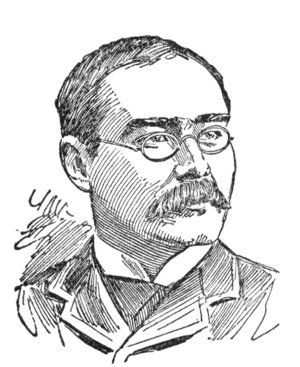
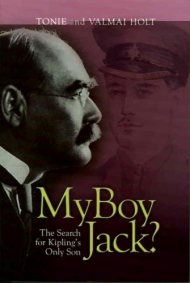
This is a poem written in 1919 by Rudyard Kipling and his editor and friend Andrew Rutherford shortly after Kipling’s only son was killed in a World War I battle.

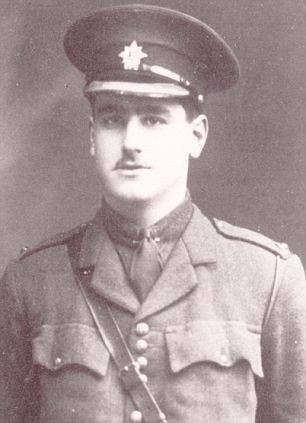
From a historical perspective, Kipling’s son had poor eyesight and was exempt from serving in the military, but the boy wanted to due his duty to his country. Kipling’s influence helped to get son in the military and onto the battlefield.

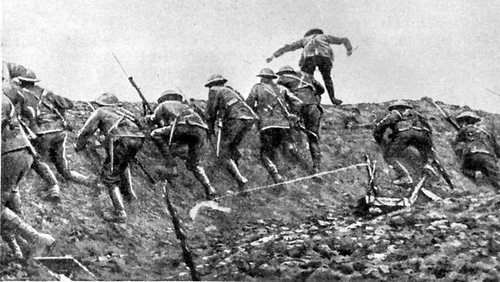
It was during these horrid years, the young men of British villages served together in units. In them was distilled the belief to fight and die for God and Country. When the cry was ordered to “go over the top” meaning to get out of the trenches and try to overtake the ground held by the enemy, thousands of young men were shot and killed. This left their home villages tragically bereft of young men.

The poem demonstrates Kipling’s ire and disbelief in the failed system that promised valor and glory and ended in grief, loss, anguish and disgust with the system. It reminds me of the Henry Wadsworth Longfellow poem, I Heard the Bells on Christmas Day. Longfellow's son Charles went off to join the Civil War without his father's permission. Young Charles was severely wounded during a battle but survived. Longfellow's poem recounts the senselessness and apprehension of war.

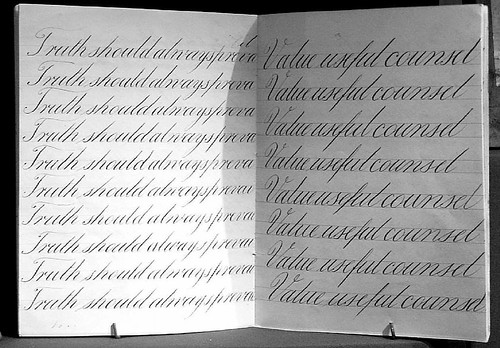
Copybooks were the note pages used by British students to write their assignments. There were maxims or proverbs printed at the top of the pages extolling virtues such as honesty of fair dealing. Students were encouraged to write these over and over to commit them to memory and put them to use in their lives.


The period of time leading up to World War I when Britain was in the midst of much social progress; schemes that promised a better life for all through social engineering, politics and philosophy. Some of these ideals went against the grain of natural law. Worship of market place ideals were hailed over traditional religion.

The philosopher George Santayana told us those who do not remember the past are condemned to repeat it. He also said only the dead have seen the end of war. This poem echoes these facts.

I cannot recall a time since when I was a young man in my late teen years that the United States has not been engaged in some form of war. Even as a child growing up, the threat of the Soviets using the nuclear bomb to attack a city in the United States loomed large. The draft of 18 year old men threatened my generation and left its mark on cemeteries throughout this nation.

We have just had a national election which sealed the disgust and national anger against the current administration and our president. Despite the election nothing has changed; in fact things are becoming worse.

Those words fashioned in 1919 still ring true in 2014