Wednesday, September 14, 2005

Mennonites


I belonged to the Church of the Brethern for a brief period of time. They were a humble, loving, sweet and peaceful people. This is a poem by Julia Kasdorf, from her book "What I Learned from my Mother"

Mennonites

We keep our quilts in closets and do not dance.
We hoe thistles along fence rows for fear we may not be perfect as our Heavenly Father.
We clean up his disasters. No one has to call; we just show up in the wake of tornadoes with hammers, after floods with buckets.
Like Jesus, the servant, we wash each other's feet twice a year and eat the Lord's Supper,

afraid of sins hidden so deep in our organs they could damn us unawares, swallowing this bread, his body, this juice.

Growing up, we love the engravings in Martyrs Mirror: men drowned like cats in burlap sacks,the Catholic inquisitors,

the woman who handed a pear to her son, her tongue screwed to the roof of her mouthto keep her from singing hymns while she burned.
We love Catherine the Great and the rich tracts she gave us in the Ukraine, bright green winter wheat, the Cossacks who torched it, and Stalin,who starved our cousins while wheat rotted in granaries.

We must love our enemies.

We must forgive as our sins are forgiven, our great-uncle tells us, showing the chain and ball in a cage whittled from one block of wood while he was in prison for refusing to shoulder a gun.
He shows the clipping from 1916:
Mennonites are German milksops, too yellow to fight.
We love those Nazi soldiers who, like Moses, led the last cattle cars rocking out of the Ukraine, crammed with our parents—children then—learning the names of Kansas, Saskatchewan, Paraguay.

This is why we cannot leave the beliefs or what else would we be?
Why we eat 'til we're drunk on shoofly and moon pies and borscht.

We do not drink; we sing. Unaccompanied on Sundays, those hymns in four parts, our voices lift with such force that we lift, as chaff lifts toward God.

Monday, September 12, 2005

Where Is the Outrage?


If an event such as this happened in the United States, would the ACLU speak up? We have plenty of historical preservation societies that are protesting destruction of old buildings. There is a public outcry if a church or synagogue is demolished. Why is the Church not speaking it's voice? Solomon's Temple was desecrated in much the same manner. What was that about history repeating itself? Nothing really changes, does it?

GAZA CITY — Palestinians surged triumphantly into demolished Jewish settlements in the
early today, torching empty synagogues and firing shots into the air, as the last Israeli soldiers withdrew after 38 years of occupation.

The troops' departure marked the final step in the government's decision to leave Gaza, which
Israel captured in the 1967 Middle East War, and opened an era laden with uncertainty for the coastal enclave's 1.3 million Palestinian residents. Having evacuated about 8,500 Jewish settlers last month and overseen the razing of their homes, the 3,000 Israeli soldiers moved out before sunrise in convoys of tanks and armored personnel carriers. As they left, calls went out from mosques declaring Gaza's "liberation."

"This is a day of happiness and joy that the Palestinian people have not witnessed for a century," President Mahmoud Abbas said.

At the former Netzarim settlement in northern Gaza, one of several places where crowds pushed past cordons of Palestinian police after the Israeli troops had left, thick clouds of smoke darkened the sky at dawn.

Men made their way around the demolished community on bicycle, donkey and foot, scavenging door frames and toilets. Some in the crowd tied the flags of the largest militant groups — green for Hamas, black for Islamic Jihad — around their necks as capes.

"It's ours now, and I had to come out to see it with my own eyes," said Raed Dashan, 29, of Gaza City.

Celebrating Palestinians set fire to the synagogue in Netzarim, and there were reports of similar torchings in Morag and other locations. Palestinian security forces appeared to have decided not to use force and instead let the celebrations play out, although it was unclear whether they could have held back the crowds if they had wanted to.

The Israeli Cabinet held its final vote on the pullout Sunday. Within hours, Israeli military commanders in the Gaza Strip had lowered their nation's flag, and the first convoys of armored vehicles began carrying equipment out of the territory.

In a last-minute reversal, the Cabinet voted to leave intact more than two dozen synagogues in the former settlements, despite warnings from Palestinian Authority officials that they could not ensure their protection. Palestinian officials announced late Sunday that they would demolish the buildings.

Palestinian leaders' displeasure with the Israeli Cabinet's decision on the synagogues prompted them to boycott a hand-over ceremony with Israeli commanders at the Erez crossing between Israel and the northern Gaza Strip.

Last month, Israel evacuated all 21 Jewish settlements in Gaza and four tiny communities in the northern West Bank', an area its forces also seized during the 1967 conflict. The moves marked the first time Israel had abandoned established settlements in areas the Palestinians hope to make their own state.

Preparations for the troop pullout unfolded Sunday in an atmosphere of historic significance, with Israeli commentators assessing the long Israeli presence, and ordinary Gazans, especially those living in towns and villages nearest the former settlements, expressing plain joy.
"We're so, so, so happy," said Yehiyeh Bashir, a 55-year-old father of nine whose house in the village of Deir al Balah overlooked the settlement of Kfar Darom. He and neighbors pulled up white plastic chairs and sipped tea, watching the slow, rumbling movement of Israeli tanks in Kfar Darom, now a wasteland of rubble.

A carnival air hung over much of Gaza. Teens keeping lookout shouted excitedly to one another whenever a tank began moving. Women ululated in celebration, and car horns honked. Trucks mounted with speakers moved through the streets, playing Palestinian nationalist songs and waving Hamas or Islamic Jihad flags.

Controversy over the synagogues within Israel's government crackled until the last minute, when the majority of Cabinet ministers reversed course by voting against demolition after intensive lobbying by rabbis who opposed the razing of the houses of worship. Private homes in the evacuated settlements had already been demolished.

The 14-2 Cabinet vote overturned a 15-month-old government decision to destroy synagogues as part of the evacuation.

The Cabinet decision to leave the synagogues in place crossed party lines, but commentators said the shift appeared to have been influenced heavily by maneuvering in Prime Minister
Ariel Sharon''s conservative Likud Party.

The party's hard-line central committee will meet in two weeks to decide whether to hold an early primary and, Israeli analysts said, ministers were mindful of how the synagogue issue would play out among its members, many of whom are religiously observant. The tide began to turn late last week, when Defense Minister Shaul Mofaz, who previously had spoken in favor of demolition, announced that he now opposed destroying the synagogues. On Sunday, Sharon said he too had changed his mind.

The decision left the fate of the synagogues in Abbas' hands. Palestinian officials had turned down an earlier Israeli request that they act as caretakers because of concerns that they could not prevent militants from defacing the synagogues as symbols of the Israeli presence.

"It is a very unfair decision to put us in a situation where if we demolish them we will be doomed, and if we don't, we'll be doomed," chief Palestinian negotiator Saeb Erekat said. "This is the last thing we want."

Other critics said desecration of the buildings by Palestinians might spur Jewish extremists to attack Muslim houses of worship in retaliation, setting off a new cycle of conflict.
The Cabinet's vote was its last on the Gaza evacuation, which has dominated political debate in Israel for a year and a half. Sharon proposed leaving Gaza, the scene of frequent clashes between Israeli soldiers and Palestinian militants, as a way to reduce friction and allow Israel to focus on retaining its much larger settlements in the West Bank. On Sunday evening, Israeli soldiers lowered their nation's flag in a ceremony at the army's Gaza division headquarters near the former settlement of Neve Dekalim.

"This is the beginning of a new chapter," the division's commander, Brig. Gen. Aviv Kochavi, said during the solemn, 20-minute event. "The strip is being transferred to our neighbors. It's the beginning of a new reality, which only the future will tell what it holds for us."

It remains to be seen whether the Israeli troops, once departed, will stay gone for long.
Israel has promised to respond harshly to volleys of rockets or mortar shells fired by militants from Gaza into southern Israeli communities. Israel also could strike if it sees the Palestinian Authority as doing too little to rein in fighters or arms smuggling.

Abbas has orchestrated seven months of relative quiet by coaxing militant groups, particularly Hamas, into halting their attacks. But Israel wants him to confront the militias more forcefully, saying Palestinian leaders' success in subduing armed groups will help determine whether future peace moves are possible.

"For the first time, not only in 38 years, but ever, Gaza is given the opportunity to act like a state, with its own regime," Giora Eiland, Israel's national security chief, told Israel Radio on Sunday.

But Palestinians say it is premature to declare an end to Israel's military occupation until it gives up control of border crossings and allows them to reopen the airport and construct a seaport.
"By reserving itself the ability to invade the Gaza Strip and by maintaining control over Palestinian airspace, territorial waters and most importantly its borders, Israel will continue its military rule over Palestinians," Civil Affairs Minister Mohammed Dahlan said in a statement.

Saturday, September 10, 2005

775th Field Artillery Battalion - 3rd Army

I just got back from enjoying a few days with my Dad's old Army buddies. There are only about 10 of these guys left and they are all in their 80's.Most enlisted when they were 18 or 19 years old.

It was a pleasure to sit with them and hear about their lives during those days. I'd like to share the stories, but I've been sworn to secrecy. However I will drop a few hints. Digging foxholes ain't no fun at all, questionable beverages, cow procurement and midnight requisitions.

I salute you guys. And Smokey, I sure miss you.


Wednesday, September 07, 2005

5 YEAR OLD GRANDDAUGHTER MUST HAVE A PIN


I find life in this age to be ludicrous! Nowadays children have to pass an admission examination to be accepted into kindergarten. They learn to use computers when they are three years old. I know this because we purchased a computer program for kids ages 3-5. And my sweet little pumpkin has to have a four-digit personal identification number to get ice cream for her school lunch.

Princess Hope has just started kindergarten. Since the kids go all day, the school provides lunch for the kiddies, but they need to bring 50 cents if they want to buy ice cream. And who doesn't want to buy ice cream? To make sure everyone is honest, fair and accounted for, when the kindergartners buy ice cream bars, they have to type in a PIN into a computer that is connected to the cash register. (Perhaps the school sell the list of names to Equifax and Hope will start getting little kid junk mail)

In reflection, when I was five we didn't get ice cream. We did get milk, in a 1/2 pint glass bottle. A dangerous, extremely breakable glass bottle and heavy glass bottle. We also got a black cookie. A very hard black cookie. It was supposed to be chocolate. It was just black. It wasn't even sweet. Probably because we were facing the Cuba problem, the Bay of Pigs and a shortage of cane sugar in those days. Yep what we got was this hard flat cookie, a black cookie, a cookie that built character. We didn't get ice cream. Not ever! When someone had a birthday, we got milk and black cookies. There were no computers to enter in a four digit PIN code. I think we had an abacus, but no one showed us how it worked. It was in the toy box. We were deprived...I guess. No ice cream, no computer PIN code, no computer. There was no computer because there were no computer chips in 1958. No one invented computer chips. However we sat in the lunchroom and dreamed of chips. Chocolate chips. The ones in the cookies that the rich kids in the private schools were having with their half-pint bottles of milk. No hard black cookies for them. No dodge ball either.


Instead of paying for our milk and black cookies through electronic funds transfer, we used the bucket method. The milk money bucket. It was wooden, small and had a rope handle. We had to kick in 3 cents every school day for milk and black cookies. .. into the bucket.

A year later when I was six and in the first grade I was strong armed by Dr. Douglas Stephens DDS. School lunch was 35 cents a day. It was good too. I have memories of the cafeteria line that featured a five gallon tub of government butter. Real cholesterol clogging butter. Delicious! The ladies put huge gobs of it on my mashed potatoes. There was also a five gallon stainless steel bowl of grape jelly. My friend Jim freaked after seeing "The Blob." He couldn't face that jelly anymore. Large quantities of jelly gave him the jibblies.

But I digress. Dr. Stephens DDS, who was also six at the time let me know in no uncertain terms that he wanted 5 cents from me everyday. He might have collected enough money from me to pay his way through dental school had not the lunch lady contacted my Mom inquiring when she was going to get busy and pay my past due cafeteria bill. The account was delinquent and Miss Sprouse wanted it brought up to date immediately or legal action would be taken.
This ended Dr. Stephens DDS reign of terror and this was the first in a long line of bills to come, bill collectors and folks that have strong armed me.

In 1958 I never had to learn a PIN. Heck a PIN was something in Grandma's sewing kit. But now Hopie has to have a PIN to access her ice cream account. We've come a long way baby!

Sunday, August 28, 2005

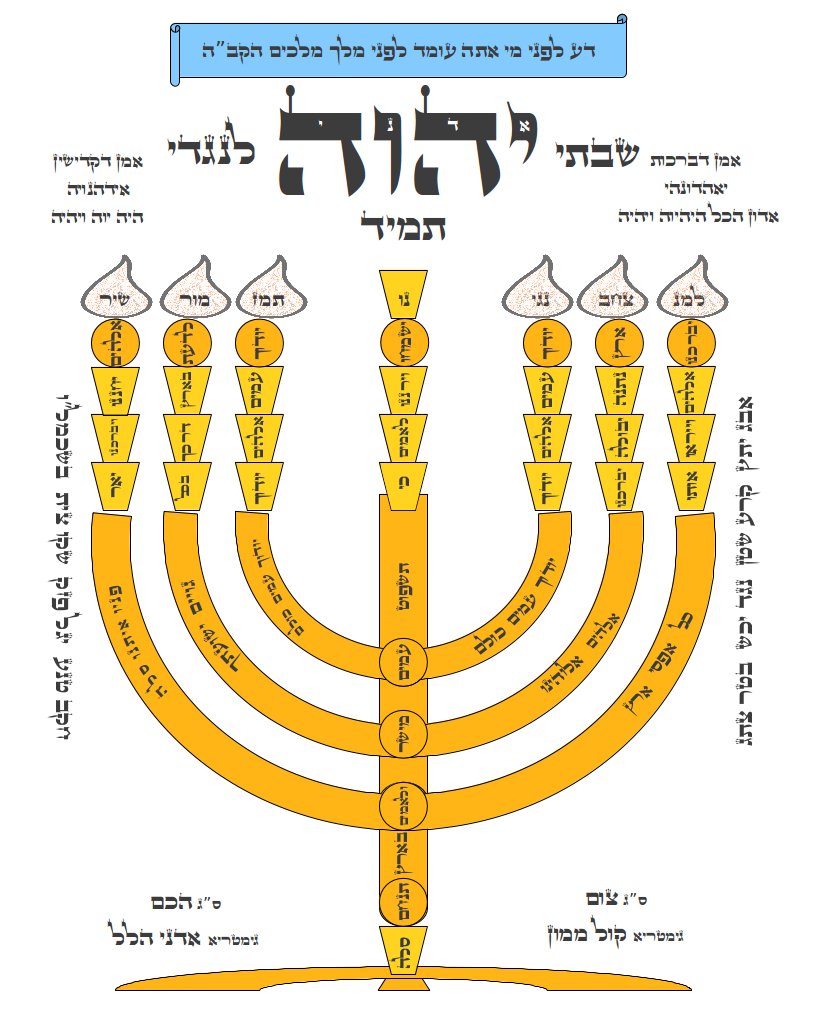
Seven Branched Menorah


My wife Linny questioned the Krauthammer article in regards to the seven branched Menorah. She had never heard of such a thing. The Menorah that we usually think of is the one with nine branches.

The original Menorah was the golden candelabra that G-d commanded the Jewish People to make and place in the Holy Temple. It had six branches and a stem, making seven lamps in all. The kohanim (priests) lit it once a day. The Torah relates its measurements and design in Exodus 25:31-40.

The Sages teach that the Menorah was the vessel that G-d used to blend the spiritual light of the World to Come with the physical light of this world. For this reason, the windows in the Temple were narrow on the inside and wide on the outside - to spread out this blended light to the world.

There is a prohibition against making a metal seven-branched menorah. This prohibition is part of the general prohibition against making vessels like those of the Holy Temple, and it was never rescinded.

Chanuka was instituted as an annual holiday the very first year after the Maccabean victory (165 BCE) to celebrate the victory and the miracle of the oil that burned for eight days.
The Chanuka menorah has place for eight candles and for a ninth candle set off somewhat from the rest. The eight candles commemorate the miracle of the oil while the ninth candle, the shamash, is for light. The first use of an eight-armed menorah for Chanuka is not known, although there are some dating back over 500 years. Menorah to celebrate the Maccabean victory has Nine branches too recall the nights that the oil continued to burn.

What follows is some information regarding restrictions from the Talmud for reproducing the Seven branched Menorah:

The Talmud forbids manufacturing a seven-branched candelabrum, in keeping with the Biblical prohibition of "imitating" any of the vessels (keilim) that were used in the Mishkan (Tabernacle - literally "Dwelling".)

There are three views in the early commentaries in regard to the extent of the prohibition. Some hold that only an exact replica is prohibited. Any slight change from the original in the Mishkan is permitted. Others hold that any menorah which would have been considered kosher b'dieved, is prohibited. Other poskim are even more stringent. They hold that any seven-branched menorah, made out of any metal, regardless of its shape or form, is prohibited.

The Shulchan Aruch rules [in the opinion of the Shach] in accordance with the second view, i.e., that even a menorah that is not made exactly like the one in the Mishkan but would be kosher b'dieved is prohibited. He rules, therefore, that if the menorah is not made from gold but from other types of metals; if the replica is made without the decorative cups, knobs, or flowers that were part of the original menorah; if the menorah is shorter than the 18 tefachim (4.5-6 feet) that the original menorah measured, it is still prohibited to replicate.

There are, however, some poskim who follow the third approach, that a menorah which would not have been considered kosher even b'dieved is still prohibited. In their opinion, it is forbidden to make any menorah, no matter what its shape or form, if it has seven branches. Even a menorah which is made to hold candles and not oil would be prohibited according to this strict interpretation of the halachah. A menorah which is round or square would also be prohibited. There is a debate among latter-day poskim as to whether the halachah should follow the [Shach's interpretation of the] Shulchan Aruch's lenient ruling or the stricter ruling of other poskim.

The poskim are also undecided about whether the prohibition applies only to the manufacture of such a menorah, or also to keeping it in one's possession. The poskim are also in doubt concerning the status of an eight-branched menorah of which one branch broke off (11).
Since this prohibition is of Biblical origin, we must, wherever possible, be stringent when in doubt.

Therefore:
Any menorah with six, eight, or nine branches may be made and kept in one's possession.
It is prohibited to make a seven-branched menorah out of any metal whatsoever.

A seven-branched menorah made out of wood or porcelain is permitted.
A round, triangular or square menorah with seven branches is also included in this prohibition.

Many poskim permit a seven-branched electric menorah, while others forbid.
Ideally, it is best to refrain from making one. If one happens to have such a menorah, many poskim allow one to retain it.
Notes:
Shach Aruch refers to a famous Rabbi and teacher of Torah, Rabbi Shabse HaCohen whose name is generally referred as the acyronym "Shach."
Poskim is the plural of Posek which translates "legal decisor" or a Spiritual leader of a Jewish congregation; qualified to expound and apply Jewish law. A rabbi who decides the facts about Halakha in cases of law where previous authorities are inconclusive. This decision is known as a psak din or psak halakha a ruling of law or simply a "psak". In Hebrew, פסק is the root implying to stop or cease - here the posek brings the process of legal debate to finality. Piskei Din are generally recorded in the literature.
B'dieved comes from a Hebrew word for permitted. Generally in the sense that it is questionably permitted. It literally means "hiddeness or concealment".

Thursday, August 18, 2005

A Note From My Daughter Elizabeth


A man and his dog were walking along a road The man was enjoying the
scenery, when it suddenly occurred to him that he was dead.

He remembered dying, and that the dog walking beside him had been dead for
years. He wondered where the road was leading them.

After a while, they came to a high, white stone wall along one side of the
road. It looked like fine marble. At the top of a long hill, it was broken
by a tall arch that glowed in the sunlight.

When he was standing before it he saw a magnificent gate in the arch that
looked like mother of pearl, and the street that led to the gate looked
like pure gold. He and the dog walked toward the gate, and as he got
closer, he saw a man at a desk to one side.

When he was close enough, he called out, "Excuse me, where are we?"

"This is Heaven, sir," the man answered.

"Wow! Would you happen to have some water?" the man asked.

"Of course, sir. Come right in, and I'll have some ice water brought right
up."

The man gestured, and the gate began to open.

"Can my friend," gesturing toward his dog, "come in, too?" the traveler
asked.

"I'm sorry, sir, but we don't accept pets."

The man thought a moment and then turned back toward the road and continued
the way he had been going with his dog.

After another long walk, and at the top of another long hill, he came to a
dirt road leading through a farm gate that looked as if it had never been
closed. It was a beautiful farm with gardens and orchards. There was no
fence.

As he approached the gate, he saw a man inside, leaning against a tree and
reading a book.

"Excuse me!" he called to the man. "Do you have any water?"

"Yep, sure, there's a pump over there, come on in."

"How about my friend here?" the traveler gestured to the dog.

"There should be a bowl by the pump."

They went through the gate, and sure enough, there was an old fashioned
hand pump with a bowl beside it. The traveler filled the water bowl and
took a long drink himself, then he gave some to the dog.

When they were full, he and the dog walked back toward the man by the tree.
"What do you call this place?" the traveler asked.

"This is Heaven," he answered.
"Well, that's confusing," the traveler said. "The man down the road said
that was Heaven, too."

"Oh, you mean the place with the gold street and pearly gates? Actually,
that's Hell."

"Doesn't it make you mad for them to use your name like that?"

"Nope. We're just happy they screen out the folks who would leave their
best friends behind."

Soooo...

Sometimes, we wonder why friends keep forwarding jokes to us without
writing a word. Maybe this will explain.

When you are very busy, but still want to keep in touch, guess what you do?
You forward jokes.

When you have nothing to say, but still want to keep contact, you forward
jokes.

When you have something to say, but don't know what, or don't know how, you
forward jokes.

Also, to let you know that you are still remembered, you are still
important, you are still loved, you are still cared for, guess what you
get? A forwarded joke.

So, next time if you get a joke, don't think that you've been sent just
another forwarded joke. Realize that you've been thought of today, and
your friend on the other end of your computer wanted to send you a smile.

You are welcome @ my water bowl anytime.

Wednesday, August 17, 2005

Excerpt from "Boys Will Put You On A Pedestal (to look up your skirt)


See, in New York City, owning a big ol' pump-action shotgun requires a license, which requires fingerprinting, so I have to go get it done. Then I'll be ready when the first boy comes to my door to pick up one of my daughters for a date. I want him to find me sitting in my chair, oiling up the barrel. That way he'll be in the right frame of mind when I ask the question, "What time were you planning on having her home, son?" Maybe I'll jack a round into the chamber (with that satisfying chick-CHICK noise) just for effect.

Just about every father of a teenage girl in the world has had a similar thought: substitute the words pistol, hunting knife, sword or heat-seeking nuclear device for shotgun, and I figure you have all of us dads covered. We live in fear of your dating. We know boys — we were boys — and now that we're the old guys in the situation, we have a pretty good idea of exactly what goes through the minds of the young guys. So we fantasize about arming ourselves.

What we don't know, of course, is what goes on in your mind. We didn't then and we don't now. That's why we can't ever seem to give you enough credit for being able to take care of yourself. But don't hold that against us, because no matter how terrible we are at conveying it, we really do just want you to be happy and safe. Even if that means we have to remove a few boys, along the way. (Sorry. The "I'm gonna hunt down and kill any boy that tries to touch you" joke is an automatic thing, for fathers. The best version ever is in the movie "Clueless," when Alicia Silverstone's father tells a boy, "Anything happens to my daughter, I've got a .45 and a shovel. I doubt anybody would miss you."

It doesn't help us dads that we barely even recognize the boys who show up at the door. What's with the gobs of hair product. Are all those sharp, gel-created points on their heads meant as some bizarre form of self-protection? And is it really necessary to wear pants so baggy that they would safely hold a family of five? Boys look so different from what we looked like at their age that it confuses us; it makes us wonder what else it is we don't know about the boys you hang around with.

Most of all, though, we're freaked out by the boys that you'll go out with because they represent the beginnings of your independence. Deciding who you'll date is maybe the first big decision you'll make entirely without us. (Oh, we'll try to make suggestions, but you won't listen. And you'll be right not to. Mostly.) We look at these boys who come into our homes — and your life — and we search them for clues about you. About what you're looking for and what kind of woman you'll become. In some ways, your choices about boys tell us more about you than anything else.

So have a little patience with your dad, okay? This dating stuff is hard on us.

It's no picnic for you, either, because while we're getting all weird and making jokes about shotguns, you're taking your first steps toward romantic relationships, and as often as not, those steps feel like they're taking place in a minefield. How do you know if you're choosing the right guys? Why don't they just come out and tell you what they're thinking, like your girlfriends do? How serious should you let yourself get with someone?

These are all things you're going to have to sort out for yourself, but that doesn't mean your folks can't give you a little guidance. As tempting as it will be for me to comment on every boy who comes through my door, I'll try to hold my tongue. Except, that is, for offering three little rules that might make the dating minefield a little more manageable.

First, make sure that you date boys because you honestly like them. Duh, right? Well, as obvious as it may seem, it's advice a lot of people don't follow. You'll watch plenty of relationships spring up for motives other than romantic attraction. You'll see girls pick guys based on their popularity, their car, or any one of a hundred other reasons that have nothing to do with a real spark. And while it's undoubtedly fun dating a guy just because he can spend a ton of money on you, it's also not very smart. When you make money the basis for a relationship, the only important person in that relationship is the one who has the money, you know? You become just another object that money brings, like an mp3 player or great clothes. And, like those things, you'll be replaceable.

Second, date guys within a year or two of your own age. My friend Alana always went out with much older guys. "I was so impressed with their confidence," she told me, "and my friends thought I was really sophisticated, because these guys chose me."

In junior high, she dated high school boys. In high school, she dated college boys. By the time she graduated, she found herself going out with guys a decade older than she was. She also found herself miserable. Because no matter what her friends thought, she wasn't that sophisticated, and her boyfriends didn't mind letting her know it. "I always felt inferior, because they seemed to know so much more than I did about everything, and while they loved to show me off to their friends, they had no patience around my friends." The last straw came when she was having dinner with a 31-year-old lawyer she'd been dating and his friends, and she voiced an opinion about politics. "No offense," her boyfriend said, "but you're 22. What could you know about it?" He was her ex-boyfriend before dessert was served.

What Alana realized was that relationships are supposed to be about sharing experiences, about learning things together. Looking back at her whole dating life, she suddenly felt stupid. "Everything I was going through, the guys I dated had been through years before me. The stuff they were going through, I was too young for. We had nothing to talk about!"

But while holding a conversation with Alana seemed too challenging for her boyfriends, they didn't have the same problem with sex. Being sexual with them became her way of trying to feel like their equal. It didn't work very well. She lost her virginity to a guy who couldn't wait to take her home as soon as it was over, so he could get back to his friends. "I was so not ready, and I got very shaky, afterward. He kept saying, 'What's the big deal? It's just sex.' And for him, it was. Been there, done that. For me it was something that should have been incredibly intimate and special, and I threw it away to hang on to a college guy."

Still, she kept dating older guys. Alana had gotten so used to the way they treated her — which was lousy — that she came to believe it was all she deserved. "By college, I had zero self-esteem," she says. "These guys basically wanted me for sex and to show off to their friends, and I thought I was lucky! If I had a time machine, I'd go and find myself at the age of 14, I'd shake that girl by the shoulders, and say 'Why should guys respect you when you don't even respect yourself?' "

Which brings me to the third, most important rule of dating: make sure that your boyfriends treat you with respect. Always. If they take you for granted, dump 'em. If they try to pressure you into something you don't want to do, dump 'em. If they ever touch you in any way that isn't invited and affectionate, dump 'em. (Then tell an adult. If you can't tell your folks, tell a teacher or an aunt or anyone with enough experience to help you handle it.)

Ever heard of a zero-tolerance policy? It's a fancy way of saying "no second chances." Zero-tolerance is a great rule to have in place when it comes to your love life. That doesn't mean you can't argue with a guy you're dating, or even forgive him for being immature, at times. What it does mean is that no matter what's going on between the two of you — good or bad — you always feel respected. You always feel valued for what you bring to the relationship.

If you have to exercise the zero-tolerance policy, and actually dump a guy, you'll feel lonely for a bit. You'll worry that no other boy is going to want to date you, because you're such a pain. And yes, the boys you break up with because they don't treat you well will tell their friends you're a pain. (Or a bitch, which is the Official Favorite Word of Guys-Who-Treat-Girlfriends-Like-Dirt™.) The thing is, you won't get the reputation you'll worry about getting. At least not among the guys who deserve your time. They'll see a girl who knows what she's worth, and isn't willing to accept any less. And deep down in a place most guys don't even know they have, they'll think, "If a girl that self-confident chooses me, it must mean I'm worth something, too." Any boy who makes that realization is a boy you can bring home to meet your dad.

I'll try to remember to wash the fingerprinting ink off before I shake his hand.

Excerpted from “Boys Will Put You on a Pedestal,” by Philip Van Munching.